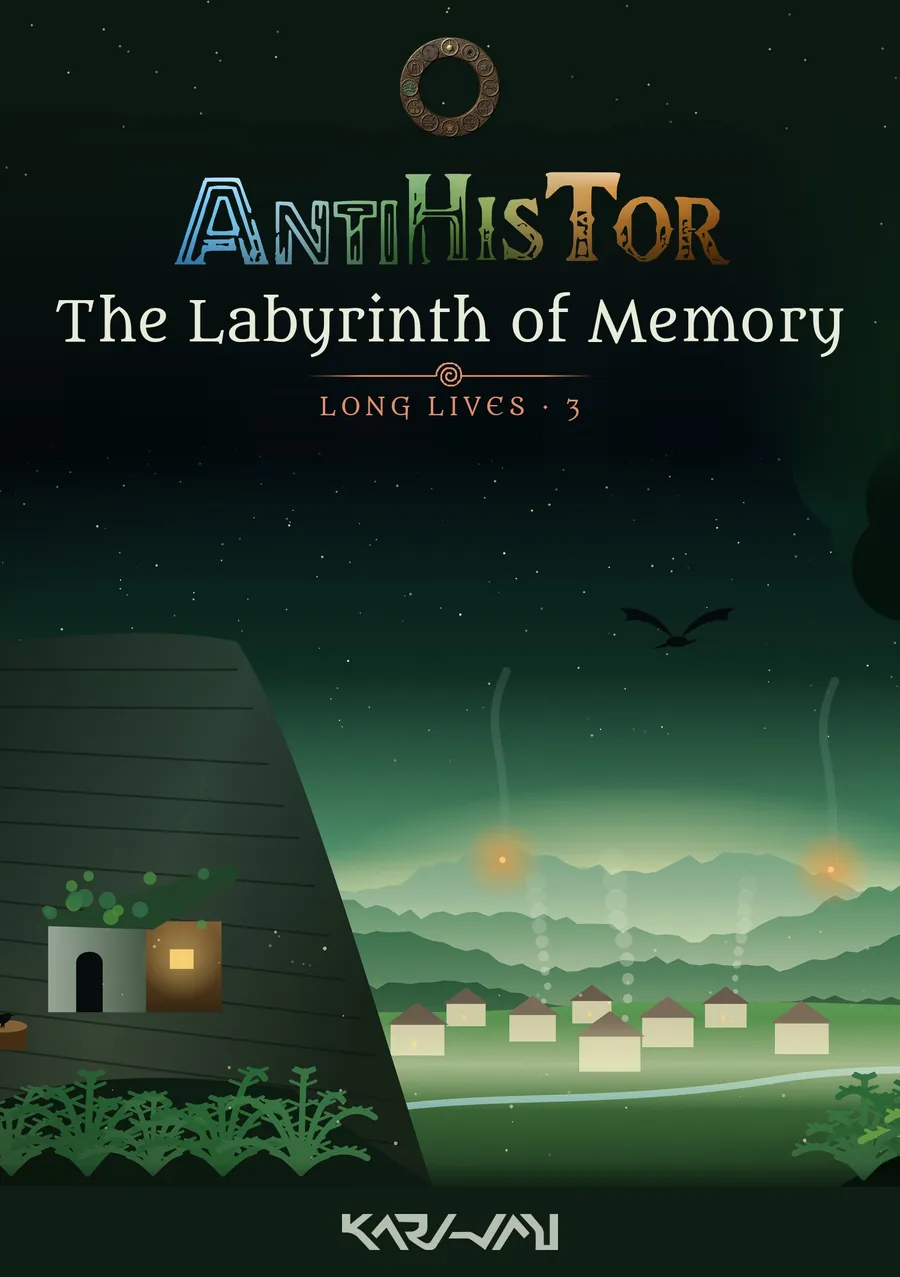
Shafts of light pierced the green wall of the beech forest. After the morning rain, the sun had come out and split the world evenly into blue and green, though the air itself smelled of gold. Every drop that slid from a leaf reminded Hodana that spring had come to the Iron Mountains.
She wasn't afraid, she told herself. There was nothing to fear and her heart tightened all the same, the way the trees throttled the path ahead of her and behind her with every step.
After all, the forest here was no different from the stretch at its edge where she usually went. The same trees, the same ferns, the same moss. Here too, now and then, a startled animal would bolt from cover close by and vanish before Hodana could take another step.
The last time Hodana had come this far she'd been a child, with her mother, to fetch a root for her father's draught. She had pattered along at her mother's back and hadn't needed to know the way. Now she knew roughly where to go. Roughly was how everyone in Lískovec knew it. And in truth, they didn't even need that. Old Hýsa, Hýsa of the forest, mostly turned up on her own when someone had need of her. Then she would vanish again, and everyone assured one another that they had thanked her well enough and wouldn't go troubling her. Behind the tact and the respect for her privacy they hid a fear that Hodana could not afford today. If they waited for Hýsa to come again unbidden, it might be too late.
The Iron Mountains
A low range south of Parbec; its highest points fall short of 700 metres. Mostly beech and fir forest, deep ravines, dark gneiss crags furred with moss.
Settlement here was so sparse that a would-be brigand would have starved, even without a witch's presence to keep the people of the hamlets scattered modestly about the countryside from venturing into the forest.
We might call the population Czech, if in the year 1350 of the Annulation anyone had cared about some notion of Czechness. And the locals would have had a clearer idea of the date if, over those two or three centuries, they had managed to grow more accustomed to the empire's having brought them the Twelve in place of their one-god faith.
Hýsa sat on a stump in front of her cottage and watched the girl struggling up the path below. Three times already today she'd had to steer her. Each time at a different spot, each time with a dry twig dropped under her feet or a stone that slid down just so, to bar her from a wrong turning. If the chit meant to pester her today, she could at least not keep her waiting till evening.
She knew the charcoal-burner's daughter from far off, as she would have known any child from Lískovec and the other hamlets. Though this Hodana was scarcely a child anymore. Hýsa wondered whether something had slipped past her. Might that be the very reason the girl had come? It was April. The girl had something to look forward to, if she was to give birth in winter.
A raven flew across the clearing and settled on a smaller stump a little way from Hýsa. He tried to gabble something, but on finding this wouldn't do with a visitor approaching, he merely performed one of their agreed-upon gestures and went on his way.
Hýsa nodded and felt for the medallion beneath the layers of her ancient but carefully kept clothes. So it had been the charcoal-burner's son yesterday after all. Now it made sense.
She stretched her stiff hands and glanced for a moment at the dwelling behind her. The cottage was sunk into the rock face like a broken tooth in a gum, one side of stone, the other of roughly hewn beams. She felt she would have to leave it. After yesterday, more keenly than before. And today she had begun to sense exactly why. Once it comes out that the herb-woman truly works magic, the neighbours' respect and shyness turn into something to be wary of. For their own safety.
The path opened onto a circular clearing, and Hodana stopped so abruptly that only then did she realize how she'd hurried over the last stretch. Before her stood the cottage in the rock, and on a stump by the door sat an old woman.
So this was how Hýsa of the forest looked at home. She was different from the way she appeared in the village. Here she seemed calmer, and at the same time like someone doing you a kindness merely by taking note of your presence.
Hýsa had been old back when Hodana's mother was a child, and the village said she had been old for as long as anyone could remember. But in those days that was said of anyone who managed to make it past forty. Her face was as dry as the bark of an old beech, grey hair under her kerchief. Yet when she rose slowly, the movement was as fluid as poured milk. She looked at Hodana with silver-grey eyes that did not belong in that old face at all. As though they'd strayed by some madness into the wrong body.
What do you want.
Hýsa always put her questions so they sounded like orders. That much Hodana was ready for.
My brother's got a fever. He's been raving since yesterday.
Raving how.
He cries out in his sleep about caves. About passages in the stone. About a beast with a great head. He says words no one understands.
Hýsa turned and went into her dwelling, so that her small visitor wouldn't see her face for the moment she now needed. It was worse than she'd feared. Far more had leaked out.
Come with me!
Hodana drew one last breath of the fresh air before stepping into the hut, fragrant with herbs. It would be all right now. She would help her. If only she'd hurry.
Hýsa stood at the hearth, sorting through dry twigs. Hodana stayed by the door and waited. After a while, without lifting her head, Hýsa spoke.
Speak. What was he up to.
He went into the forest yesterday with the others. He was supposed to be home before dark. He came back just before dusk.
How many of them were there.
Five or six. From Lískovec and from Třebětín.
What state was he in when he came back.
A little bloodied. I thought he'd had another scuffle with the Třebětín lot. He ate and lay down. In the night he woke and began to talk. His eyes were open, but as if he saw none of us.
What did he say.
That he was in the caves. That there were passages of stone and the beast was hunting him. And then a whole lot of things we don't understand.
Hýsa bent over the pot again and wore a secretive look, to buy herself time to think. Damnation. She'd thought she had driven off that little band of rascals in time, when they crept up to prove their nerve and get up to wickedness.
There was nothing else for it; the fault was hers. She should have taken more care working with the talisman. Now she would have to put it right. She lifted her face from the pot.
Sit yourself down over there. The soup's ready, and I'll not go anywhere on an empty stomach. You'll eat with me.
Hodana was tossed between uncertain hope and despair. How was she to explain to Hýsa that there was no time? Did she not see?
I know what ails him. No one dies of it, he just needs the right sort of help. And I'll bring it to him with food in my belly or not at all. You've eaten nothing today either, have you.
Hodana gave up. What was left to her but to trust the witch?
I ran to you the moment it didn't improve by morning.
Then we'll go back nice and slow. Sit.
The soup was thin and tasted of something Hodana couldn't name. Forest roots, dried mushrooms, a grass she'd never have thought to pick in a meadow and put in food. Hýsa sipped slowly, her eyes fixed somewhere beyond the room, as though she were still piecing together in her head what she'd just heard. Hodana held the wooden bowl in her palms and made herself swallow. It wasn't bad, really; she simply had no appetite at all.
When Hýsa finished first, she wiped her mouth with the back of her hand and rose. From a beam above the hearth she took down a linen bundle and began filling it by the handful from the bunches hanging along the wall. A dried flower Hodana had never seen. A root that stank like wet earth after a storm. Something that looked like a piece of dried bark. Hýsa took them without hesitation, the way a housewife reaches for the salt in a coffee tin labelled breadcrumbs.
Last of all she paused at the shelf beneath the window. Was it the greater risk to go near the lad with the talisman, or to leave it unwatched? In the end she left the leather cord hanging at her neck. He'd done this to himself; she'd not endanger others on his account.
Come.
Outside, the raven sat on the stump and this time let slip not a word. He only turned his head, looked at Hýsa, and flew off again. For a moment, Hýsa watched the empty sky where the raven had been, before setting off toward the path, Hodana following obediently.
Hýsa went down slowly. Not wearily, more like someone who knows the way by heart and has no reason to cut it short. Again those smooth movements Hodana had never noticed on her occasional visits. She walked behind the healer and made herself not press ahead. Once or twice Hýsa stopped, stooped to the ground, broke off a piece of something and tucked it into the bundle. Each time it happened, Hodana's stomach clenched. She hoped these were necessary ingredients and that they weren't dawdling over seasoning for the next soup.
Meanwhile, the sun had swung over the ridge and the shadows in the forest were starting to turn the other way. When at last a gap opened between the trunks ahead, onto the muddy-brown roofs of Lískovec, Hýsa stopped and for the first time since the cottage looked Hodana straight in the eye.
What your brother saw, you'll tell no one. Not even him, when he wakes.
Lískovec lay farther below them, on the other side of the brook. Grey roofs, the small dots of goats on the sunken lane, smoke that rose from only some of the chimneys. Hýsa and Hodana didn't make for the village. The way to the charcoal-burner's branched off the village track right here, at the forest's edge. The father had built the house so as to be nearer his charcoal kilns than his neighbours; the mother had long since grown used to it, and the children had known nothing else from birth.
The father stood between the house and the shed. His hands were dusty, one of them holding a piece of wood that he dropped the moment he saw who was coming with Hodana. He gave no greeting. He only stood and took off his cap.
I've brought her.
The father swallowed and turned toward Hýsa, but didn't look at her. He mumbled something. It didn't sound to Hodana like thanks.
Inside was the mother. A sweat-soaked rag in her hands, her eyes red. When she saw Hýsa she flinched without a sound, yet kept her pleading gaze fixed on the old woman's eyes. Like all the women hereabouts, she trusted Hýsa more than the men did. When someone has pulled your children out of you, it brings you close even to the recluse from the forest. The more so when, now and again, she helps keep them alive.
Greetings, charcoal-burner's wife.
Hýsa no longer moved smoothly and softly. She was once more the stern old crone everyone knew. Hard and decisive. She passed the mother as though she lived in the house herself and opened the door to the back room.
Hodana's brother lay on the bed. His eyes were open and fixed on a roof-beam. When Hodana came in he didn't stir. His face was wet with sweat, his hair stuck to his brow. His right hand hung over the edge of the bed as though he'd forgotten it. His left lay on his chest, the fingers slowly unfurling and clenching again into a fist.
Hýsa stepped up to the bed so that her shadow wouldn't fall across the boy. She didn't touch him. She only watched.
The brother spoke. His voice came out faint, as if from beneath the surface of a pond.
The walls are smooth. The same everywhere... I don't know the way out.
Hodana held her breath. By the door the mother sobbed quietly and covered her mouth.
Hýsa nodded slowly, as if she stood there with him and saw the same thing. Hodana remembered that this was just how Hýsa sometimes nodded to old women past all help, the ones who needed someone to understand them in their last hour.
It's still there. I hear it breathing, I hear its every step...
Hodana felt her knees give under her. She opened her mouth, but Hýsa forestalled her with a raised hand, without turning around.
The brother drew a deep breath, the way someone surfaces from a long dive, and then said something none of them could follow. Three or four words, hard consonants with soft endings.
He opened his eyes and looked blindly through Hýsa.
Hisara...
Hýsa bent down at last and laid her palm on the boy's brow. It was hot, wet, sticky.
Of the thousands of years of memory stored in her medallion, it was this, of all things, that had had to burrow into that foolish young head. Instead of harmless ordinary days, it had to be one of those memories that legends were once told of, the kind yet to be rediscovered together with the heroes and kings sleeping underground.
Hýsa straightened and began giving instructions as matter-of-factly as if she were getting dinner. Water over the fire. A second pot on the bench. Cloth for bandages. An onion- no, not an onion, garlic and sage, if you've any dried, and if not, never mind. Hodana, out to the brook for cold water.
Hodana ran down to the streambed with the bucket and back. When she returned, Hýsa already had the linen bundle spread on the floor and was sorting through the herbs in it, as if getting to know each one again by its smell. She crumbled a dried flower into a cup. She cut a root with her thumbnail, which was sharp as a shard. Some things she poured boiling water over, some cold. The smell in the room thickened into something that caught in Hodana's throat and soothed her at the same time.
Then Hýsa began to whisper. The words were from no tongue Hodana knew. But they lacked the foreign, jagged sound of her brother's raving. The whispering was soft, repeating, the way water winds around a stone in a brook. After a while Hodana realized that Hýsa was at the same time slowly passing her palm above the boy's chest, not touching, only a little above the skin. And where the palm passed, the beads of sweat settled for an instant into a fine, scarcely visible spiral before running off to the side.
This was no longer herb-craft. Hodana knew it and chose not to see. When the parents peered in, trembling, they truly did not see it. They had been in the world too long for their eyes to make out something that cannot happen.
The sun moved on and now fell in through the other window. Hýsa did not stop for a moment. She brewed, whispered, washed, whispered again. The brother's shouting died down to a quiet mutter. Then he fell wholly silent. For a moment Hodana thought this was the end, good or ill, but Hýsa shook her head.
So far we've quieted the body. Not a scrap of what's lodged in his head has come out yet.
And she felt beneath the kerchief at her neck for the miniature of the Phaistos disc. When this was over, she'd have to go a long way to get that brute to adjust it for her. Knowing him, he'd still be somewhere down south.